
Premium Build — Zero Structural Corrosion
Pultruded FRP Cooling Towers
— When You Need the Structure to Last as Long as the Plant
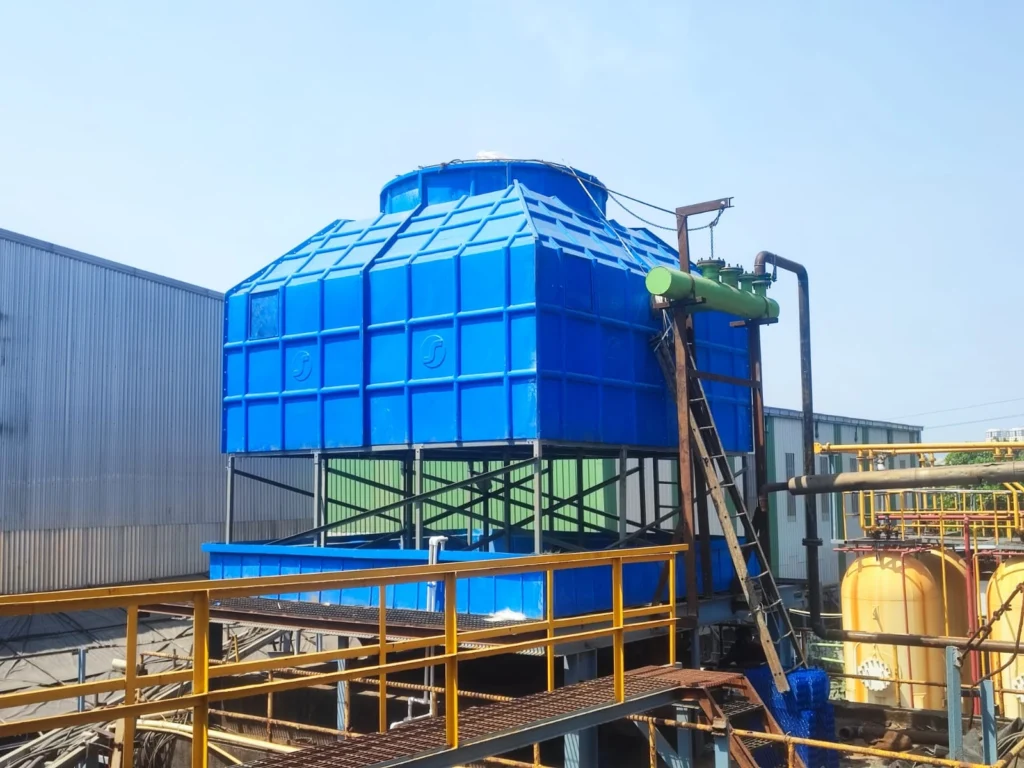
Every component of the structural frame — columns, beams, bracings, rafter arms — manufactured from pultruded FRP profiles. Zero steel in the primary structure. Zero corrosion at any connection point. Designed for plants where a 20-year maintenance-free structure isn’t a luxury — it’s a requirement.
20-25Year Structural Service Life
60-70%Fibre Volume Fraction in Pultruded Profiles
Most industrial buyers encounter pultruded FRP cooling towers when they’re solving a problem that a standard MS or even a conventional FRP tower has already failed to solve. The chemical plant in Raigad where structural steel corroded through within six years despite protective coatings. The coastal facility in Ratnagiri where salt-laden air destroyed the galvanised frame before the first fill replacement was due. The fertiliser plant where process chemical vapours turned the tower’s structural connections into a maintenance liability within four years of commissioning.
These aren’t edge cases in Maharashtra’s industrial landscape. They’re recurring stories — and they’re exactly the scenarios pultruded FRP towers are built for.
But pultruded FRP towers aren’t just for damaged-tower replacement. They’re also the right first choice for any facility where the operating environment is corrosive, where the plant horizon is 20 years or more, and where the engineering team is willing to make an upfront investment in a structure that won’t become a problem. This page explains why — in precise enough detail that you can make the decision on engineering grounds, not marketing copy.
What Is a Pultruded FRP Cooling Tower?
A pultruded FRP cooling tower is one where the primary structural members — the columns, horizontal beams, diagonal bracings, and rafter arms that hold the entire tower together — are manufactured from pultruded FRP profiles rather than steel, timber, or hand-laid FRP sections.
In a conventional FRP cooling tower (what we call a standard package tower), the casing and basin are FRP, but the structural frame is often mild steel — sometimes coated with FRP or epoxy paint for corrosion protection, but fundamentally still steel at its core. In a pultruded tower, that steel frame is replaced entirely with FRP structural profiles. The result is a tower where every load-bearing element is inherently corrosion-immune — not protected from corrosion, but immune to it at the material level.
Understanding the pultrusion process
Pultrusion is a continuous manufacturing process for composite profiles — the FRP equivalent of steel extrusion. Understanding the process explains why pultruded profiles are structurally superior to hand-laid alternatives.
STAGE 01 Fibre roving feed Continuous glass fibre rovings are pulled from creels, precisely aligned along the length of the profile.
STAGE 02 Resin bathFibres pass through a resin bath — polyester, vinyl ester, or epoxy depending on the chemical resistance requirement.
STAGE 03 Performing die Resin-saturated fibres are guided into the precise cross-section shape — I-beam, angle, channel, tube, etc.
STAGE 04 Heated die curing The shaped composite passes through a heated steel die where the resin cures under precise temperature control.
STAGE 05 Pull and cut The cured profile is continuously pulled through and cut to required lengths — consistent cross-section every time.
Key Advantages of Pultruded FRP Over Standard FRP and MS Towers
Zero corrosion at structural level
Not coated against corrosion — inherently immune to it. No paint to blister, no zinc to exhaust, no steel core underneath waiting to rust.
Superior structural strength-to-weight
Pultruded FRP profiles have a tensile strength comparable to structural steel at roughly one-quarter of the weight — reducing foundation loads and handling requirements on site.
20–25 year structural life
The pultruded frame is designed to outlast all consumable components by a significant margin — fill, nozzles, fan blades, and motors will all be replaced before the structure needs attention.
Lower 15-year total cost of ownership
Higher upfront cost, but structural maintenance costs over 15–20 years in corrosive environments are dramatically lower — typically recovering the premium within 5–7 years.
Ideal for coastal and chemical environments
Salt-laden coastal air, chlorine and sulphur compound exposure, and acid fume atmospheres — conditions that destroy MS frames — have no effect on pultruded FRP profiles.
Dramatically reduced maintenance programme
No structural inspection for rust, no repainting, no bolt replacement from corrosion-related loosening. Maintenance effort focuses on consumable components — not the frame itself.
FAQ's
In a standard FRP cooling tower, the casing and basin are FRP, but the structural frame — columns, beams, bracings — is often mild steel, sometimes coated with FRP or epoxy paint. In a pultruded FRP tower, every structural member is manufactured from pultruded FRP profiles — a high-fibre-volume composite with inherent corrosion immunity at the material level, not just at the coating surface. The pultruded frame is not protected from corrosion; it is immune to it. This distinction has major implications for structural service life and maintenance cost in any corrosive environment.
Pultrusion aligns glass fibres continuously along the length of the profile and cures them in a controlled heated die, producing a fibre volume fraction of 60–70%. This is roughly double the fibre content of hand-laid FRP and results in significantly higher tensile strength, flexural stiffness, and consistency of mechanical properties. Pultruded FRP profiles can be engineered to structural calculations in the same way as steel — with real, documented safety margins. This is not possible with hand-laid FRP sections, where fibre distribution and resin content vary between operators and batches.
Pultruded towers are custom-engineered units, so the timeline is longer than a standard package tower from stock. Typically: 2–4 weeks for thermal and structural design and proposal review; 6–10 weeks for fabrication depending on size and structural complexity; 2–4 weeks for site erection and commissioning. Total from order confirmation to commissioned tower is typically 3–5 months for a standard industrial unit. If your project timeline is tight and the environment doesn’t absolutely demand a pultruded structure, we’ll say so directly and recommend a package tower instead.
Yes — in fact, replacement of a corroded MS or galvanised-frame tower with a pultruded FRP unit is one of the most common project types we handle. The new tower is designed to match the existing piping interface, foundation footprint, and capacity requirements where possible, minimising civil work and shutdown time. If the existing cold water basin and piping can be retained in acceptable condition, this further reduces the scope of work. We carry out a site assessment as part of the proposal process to determine what can be retained and what needs to be replaced.
The maintenance programme for a pultruded FRP tower is intentionally simple compared to a steel-framed unit. Structural maintenance — the rust inspection, recoating, bolt replacement, and structural repair that consumes significant engineer time and budget on MS towers — is effectively eliminated. What remains is the standard consumable-component programme: basin cleaning (typically once or twice per year), fill inspection and cleaning, nozzle inspection for clogging, drift eliminator inspection, fan and motor maintenance per the motor manufacturer’s schedule, and water treatment monitoring. This is a significantly lighter maintenance burden than a comparable MS-framed tower, particularly from year five onward.
Specifying for a corrosive environment or a 20-year plant horizon?
Talk to our engineering team. Share your site location, atmospheric conditions, and heat load — we’ll assess whether a pultruded FRP tower is the right choice, recommend the appropriate resin system, and prepare a technical proposal with a full lifecycle cost comparison. No obligation. Just straight engineering advice.